The Durham entrepreneur pairs handcrafted drinks and desserts with a welcoming space that champions local artists and fosters community connection
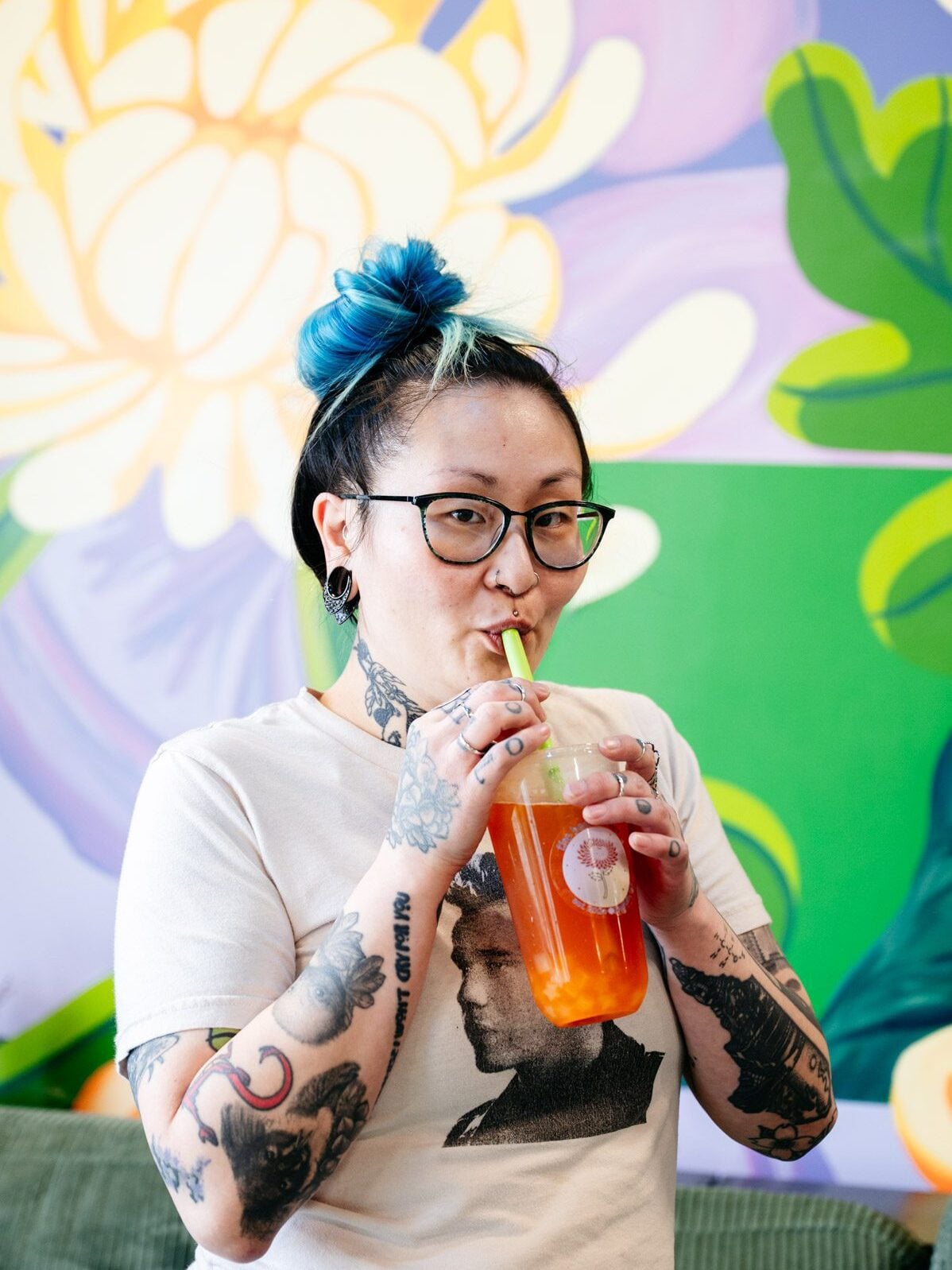
As told to Renee Ambroso | Photography by John Michael Simpson
Growing up in south Durham, CC Chu attended Durham Public Schools – Southwest Elementary School, Sherwood Githens Middle School and Jordan High School – before earning her bachelor’s in fine art from UNC Greensboro. She returned to Durham in 2021, where she currently lives with her dogs, Opus and Oliver. She opened The Bean Flower, a boba and dessert cafe that hosts craft workshops, game nights, drag shows and other community events, in summer 2024.
What was it like growing up in Durham? Having traveled around the world and around the country a lot [as an adult], I feel like this is the kind of place that a lot of people seek out in larger city settings. It’s been fun realizing that about my small hometown.
[My childhood] was unique, though, because I was not surrounded by a lot of other Asian kids growing up. There was definitely a large minority population in general, and so that part of it never really felt out of place to me – of course, there’s always some sense of othering – but there was a nice camaraderie and community of people of color even back then. Getting to watch that blossom over the last couple of decades and blow up into an even deeper, more appreciated multicultural community, it’s awesome to see where our roots were already settling in for that type of city. I’ve been proud to watch Durham grow up as I’ve grown up.
What kept you in Durham? I always knew that the end goal was going to be [living in] Durham. … As I got older and tried to reckon my cultural identity with my upbringing and where I was physically located, and how that related to my identity and personhood, I realized there’s actually so much overlap between Asian and Southern cultures. Durham as a whole embodies a lot of that, so I wanted to get back to all of the things that really matter to me and settle down in the place that I feel most comfortable.
What drew you to opening a cafe? Had you always wanted to do that, or did the concept evolve over time? I’ve known from a pretty young age that I wanted to own my own business in some capacity, but didn’t know exactly what that would look like. I didn’t know how I’d be able to make that happen. And at the time, I didn’t think that that was a reasonable dream either.
As I went through college and gained some entrepreneurial skills, I started realizing there was a way that I could carve out a space for myself. Originally it was going to look like an arts org, which it still hopefully will be in the future, but I realized really quickly that nonprofits usually come after profit-making establishments. …
Offering a sustainable platform for local artists has always been close to my heart. It’s been such a gift to have a space to do that [at The Bean Flower], and we’re lucky to have such a talented community of artists who have honored us with sharing their work.
[I started an arts organization when I got out of undergrad, and that] was really tough. … I learned a lot, and then COVID-19 happened and shook everything up. After seeing the resiliency of so many small business owners I knew … in the food and beverage industry, it made me realize that this is where I’ve always wanted to be.
Fully embracing it has been the most fun part for me. I didn’t know this exact concept would come out of it, I just knew all the things that I liked, what I was good at and the people [I could partner with]. … It happened coincidentally and organically based on a lot of factors that came together at the right time.
In general, I was trying to stay connected to my roots … trying to find a way to revisit those nostalgic tastes and memories.
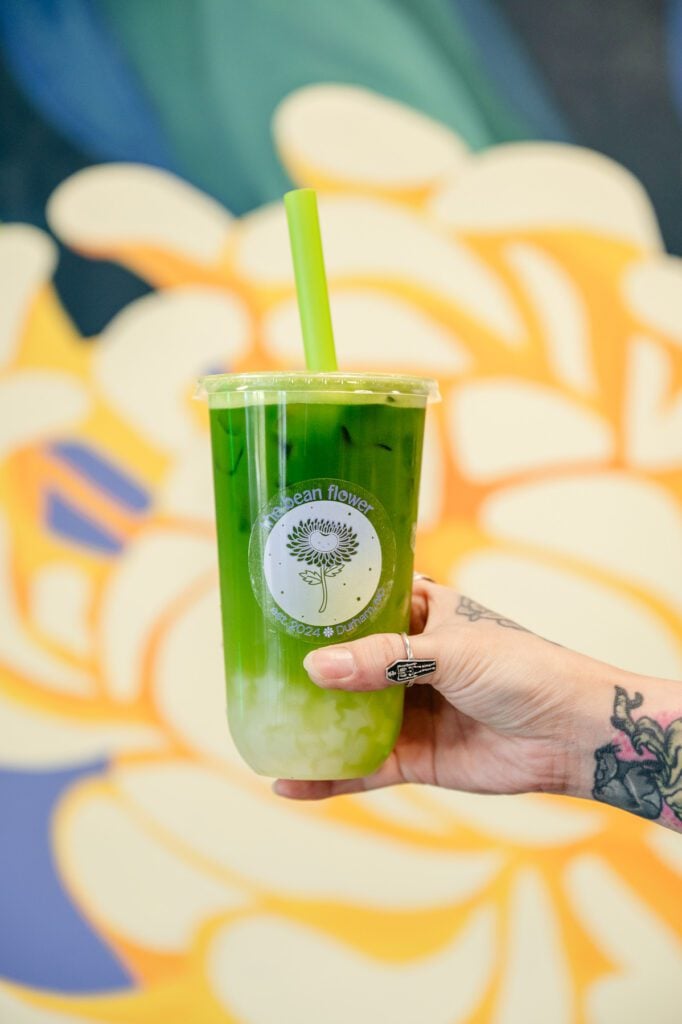
Explain the meaning behind the name. How did you come up with your mascot, Beanie? It’s basically a slight joke on my really bad Chinese. The dessert that we centered the entire business around – our tofu pudding – one of the names of that dessert in Chinese is dou hua, which, if you take each individual character, literally translates to bean flower. It is correct technically, but it’s not actually what
people call the dessert.
My general manager, Grand Cheung, and brand and marketing manager, Jianna Costiniano, and I were bouncing around ideas for names, and we hated everything until we came across that one, and it [immediately felt like the right fit].
The mascot followed from that. I had a really abstract vision in my mind that I had to then communicate to Jianna to turn into a logo. I literally said to her, “What if it were a flower, but it’s a cute little character, and instead of the middle of the flower, it’s a bean?” That’s exactly what the logo is now, but the cutest possible iteration of that.
The center represents a soybean or a red bean – the two main beans we work with in Asian desserts. The flower is a chrysanthemum, which is, for many of us, a favorite tea from childhood – it’s non-caffeinated, so it was often the kids table tea.
Walk me through the menu and tell me a little about how you decided what would be on it. We have drinks and desserts. The syrups and toppings deserve their own section, because we make all of our syrups in house, from scratch, and many of our toppings as well. We don’t use any artificial powdered mixes or premade products, and none of our syrups have any artificial flavoring.
We make fresh soy milk by hand, [which is a] very labor-intensive process. We make our regular and a black sesame soy milk using housemade black sesame paste that has no nuts in it, which is fairly rare because a lot of the [packaged] mixes and pastes will have additives to enhance flavor that can cause allergy issues.
Then we have our teas and milk teas, caffeinated and noncaffeinated. We try to offer a unique selection of flavors, both in the teas and the syrups that we offer.
We do traditional Asian desserts – what you would find in a potluck setting versus commercial shops. Making our silken tofu pudding in-house from our fresh soy milk is a really big part of what we do. We offer a lot of dessert jellies as well, and sweet dessert soups.
How do you develop seasonal items? Are there any special, limited edition menu items coming up? One of the lessons I’ve learned is that if you only sell things that you like, you are probably doing something wrong. I’ve tried to keep it open – we also take customer requests seriously as well, because that’s the goal: to bring people [food and drink] they remember from childhood that aren’t as accessible, especially in this part of the country, for a lot of Eastern and Southeast Asians.
As far as the monthly specials, we [create] a seasonal drink [based on] what’s locally available to us. That’s where we’ll highlight the bounty of North Carolina. For example, as we get into berry season, I go to as many of the local farms in the area as possible. I’ll go pick them myself if I can. We try to make sure that we’re using what’s naturally [abundant] around us [and] get everything at its peak.
We have a new section of our drink menu coming. … We’re adding some yogurt fizz drinks to our permanent menu. The yogurt drink is one of my favorites. We did our first one last May for strawberry season, and it just totally took off. Anything that has made our customer base exceptionally happy has been the most rewarding part for me.
Any exciting events on the horizon? Common Roots [Fest in Durham Central Park] takes place May 16. It’s a great [Asian American and Pacific Islander] festival that we got to be part of last year, and we hope to be out there again. We’re going to have an AAPI art show up [at Bean Flower] as well in celebration.
Our Pride show will be up for the next couple months after that, so all summer there will be some really good art in the store – local artists in underrepresented communities – that you’ll be able to come check out.
We’ve got [pop-up] events each month with a local craft facilitator. We also do queer BIPOC yarn, craft and needlework meetups every month.
You’ve said that you prioritize people over profits – how does that philosophy shape your daily decision making? The biggest thing that anyone really wants, needs or asks for is a living wage. [That’s] at the core of what’s important to me. I would not be able to sleep at night if I knew that I was running a business where the people who work for me can’t live, so I don’t compromise on that part, ever.
Day-to-day operations and the way that I approach the business comes from our team. Everybody gets to contribute. I try to make sure that everybody feels like they have autonomy and that they get to put their stamp on what we’re doing, because it’s really important that we’re doing this together and that we’re using our platform for good. [This means] not only incorporating what customers are asking for in menu items, but also making sure that we’re amplifying the customer base we have in terms of our values and the way that we’re operating as a business ethically to support other local businesses and to donate to local charitable organizations. [It’s important to] make sure that the money goes back to where we know our people who are spending their money with us would want it to go.
What’s the best piece of advice you’ve received? Great advice that I’ve gotten from my mom, [Julie Huang], is to always be looking and learning. Never think that you’re ahead of or better than a situation, because there’s always going to be something that you can take away from it. Having the humility to even look at a bad situation and find lessons is really important – not only for being an entrepreneur, but just as a human in life. It helps to have a lot of empathy and think first about what somebody else might be experiencing rather than to steamroll that with what you think you already know. Being able to put myself outside of the situation and look at it objectively and see what lessons I can take from it has given me most of the tools that I’ve used to open a business. So, very helpful – thanks, Mom.