New executive director Katie Wyatt brings a global perspective, deep roots in music education and a vision for expanding creative space and opportunity across Durham
As told to Sharon Kinsella | Photography by John Michael Simpson
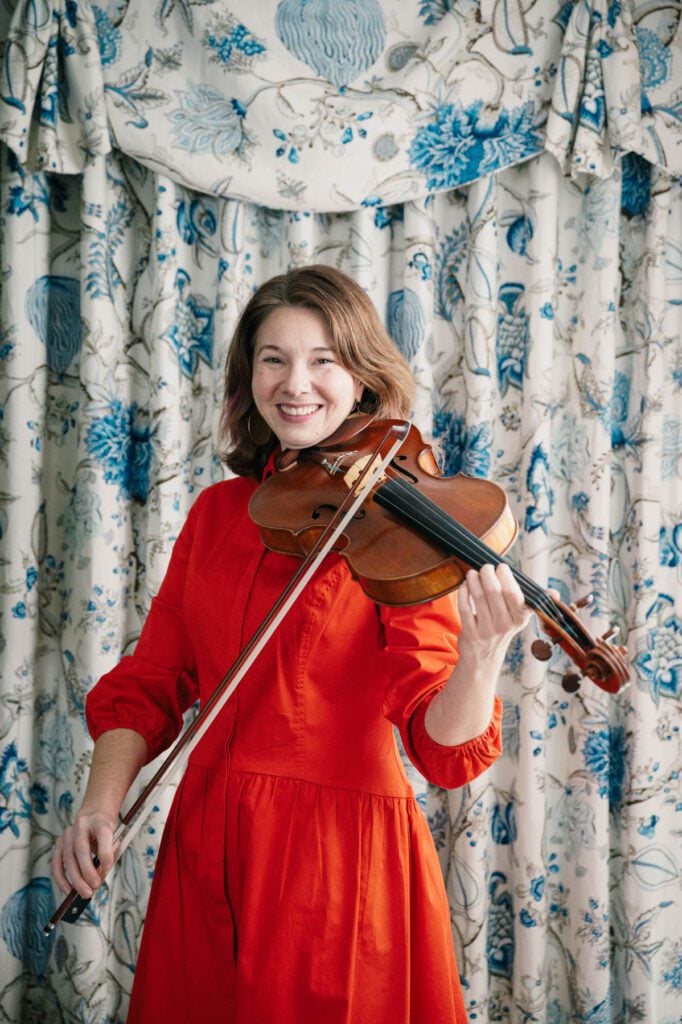
Durham Arts Council welcomed Kathryn Wyatt as its new executive director in August 2025. Katie grew up moving frequently as a daughter of parents in the armed forces, spending most of her early years in Bowie, Maryland, before attending high school in Belgium. She began playing the viola as a child and later earned degrees in music and political science from Indiana University, combining her artistic training with an interest in how the arts and culture influence laws and governance around the world. She went on to pursue a master’s degree in viola performance at the Cleveland Institute of Music.
Katie moved to North Carolina in 2006 to serve as director of education for the North Carolina Symphony. She went on to co-found the music education nonprofit Kidznotes in 2009, launching it out of the Durham Arts Council building, and later became the founding executive director of El Sistema USA. She most recently served as executive director of the Weymouth Center for the Arts & Humanities in Southern Pines before stepping into her current role.
Katie continues her music career as principal violist of The Carolina Philharmonic and as a member of the indie folk-rock band Ice Cream for Breakfast. She divides her time between Southern Pines, where she lives with her 7-year-old daughter, Petra Wyatt Vandermeer, and Durham.
*Responses have been edited for length and clarity.
What role did the arts play in your early life?* I started playing the viola in the third grade in public school. It was something I did with my sister Karen [Wyatt Pape] – she plays violin. Moving all the time, music quickly became a way for us to make friends and build community. Music has truly been my ticket around the world; the arts are what has built an international community and a global mindset for me as a person. [It’s also guided] the way that I think about doing business and the spirit of collaboration in all the work I do through arts administration.
When did you begin to see yourself not only as a performer, but also as someone who could build and lead arts institutions? The movement of El Sistema is a very deep, fundamental experience in my life. I was on tour with the Youth Orchestra of the Americas [in 2005]. I was inspired by [Venezuela’s] system of music for all. The government of each barrio supported this youth orchestra program and made sure that all the kids got their instruments and would be able to go to practice and concerts. It reminded me of Texas football towns, where the whole town is behind the team. But in this case, it was really about the orchestra and the kids and families who didn’t have opportunities like that [otherwise]. That inspired me to think about what I could do to help build that kind of community web – a network of opportunities for all people. I am very passionate about opportunities for kids, because those early years [are critical].
What are you most proud of accomplishing in your career so far? I [was selected to] the Abreu Fellows program [in 2008], and that fellowship awarded me the chance to go back to Venezuela. José Antonio Abreu – the founder of El Sistema – was honored as the TED Prize global winner, and with that prize, you get a wish to change the world. His wish was to bring 50 young musicians and artist administrators to Venezuela to bring El Sistema back to the United States, with the idea that each fellow would launch an El Sistema-inspired program in each of the 50 states. [That experience directly led me to] start Kidznotes around the same time. Kidznotes is really one of the things I’m most proud of in my life – that it’s still here, I’m still able to support it, and so many of the young musicians and their families enrolled in it have gone on to do incredible things.
How have you spent your first few months in this role, and which areas are you focusing on most? The timing is excellent [because] the cultural road map run by the City of Durham is wrapping up, and they are beginning to share some of their findings. The arts council and I have been able to respond immediately to some of those needs – one of the biggest identified is space. I quickly worked with our team to massage some of our existing grant programs.
We’ve just launched three new creative spaces grants: Creative Hours, Creative Residency and Creative Showcase. Artists can bring projects to the Durham Arts Council to work on, and it’s all free. The idea is to offer this place as a City of Durham building. The arts council is the steward of this building, but the building belongs to the community as a creative hub available for its use.
If creativity were truly within reach for everybody, what do you think that would look like in a community like ours? It would be access to mastery – this idea of having the space, time, resources and support to pursue one’s passion, and that you would be able to explore that in the public school system. You’d be introduced to everything so that you could have a sense of what inspires you. Then as that grows, and as you grow, you would have access to opportunities to be able to pursue whatever spark lit your fire. That’s something the arts council believes in as a No. 1 core value of what we do.
It’s a Small World
Katie’s path into arts administration began with a national fellowship through the League of American Orchestras from 2005 to 2006, an experience that introduced her to mentors and colleagues who helped shape her career – many of whom now work in the Triangle arts community, including:
- Deborah Rutter – Katie worked under Deborah at the Chicago Symphony Orchestra as an intern and later at the Kennedy Center for the Performing Arts during Deborah’s tenure as president. She now serves as Duke University’s vice provost for the arts.
- Jesse Rosen – Former president of the League of American Orchestras who has served on the boards of the Pauli Murray Center for History and Social Justice and the Durham Symphony Orchestra.
- John McCann – Arts consultant who also served on the Pauli Murray Center and Durham Symphony boards.
- Sandi Macdonald – Now president and CEO of the North Carolina Symphony, Sandi was Katie’s first boss in arts administration when she worked with The Cleveland Orchestra’s marketing team.