Co-founded by Marilyn Bell Hawley in 1976, Montessori School of Durham has grown into one of North Carolina’s few American Montessori Society–accredited programs, shaping generations of Durham students
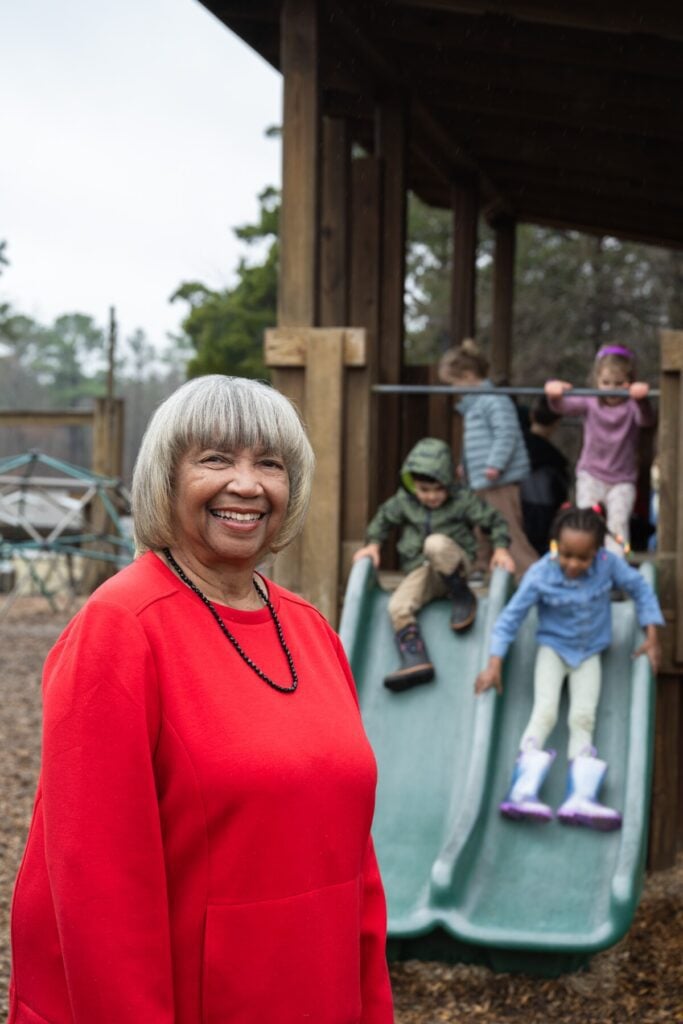
By Anna-Rhesa Versola | Photo by John Michael Simpson
When Marilyn Bell Hawley was a child, she would play in the waves of the Atlantic Ocean along North Carolina’s shores and imagine traveling to Africa. Dreams turned into destiny.
Marilyn was living in Zambia in 1970 when she encountered the work of Maria Montessori, the first woman physician in Rome who also developed the eponymous philosophy of instruction through experiential learning. At the time, Marilyn had just given birth to her daughter, Miji Bell, and some of the only early childhood development books available in English were by and about Montessori.
“I liked her,” Marilyn says. “I liked her boldness.”
That admiration sparked an idea that would transform early childhood education in Durham. After arriving back in her home state, Marilyn began helping build a school that would ultimately inspire generations of inquisitive young minds in the Bull City.
This year marks the 50th anniversary of the Montessori School of Durham, which Marilyn co-founded in 1976 with only a handful of little ones in its first class. Originally named the Montessori Children’s House of Durham, it became the first in the state to achieve accreditation from the American Montessori Society in 1996 and remains one of only six in North Carolina to maintain this distinction. The school now serves 182 students, from infants to sixth graders, across 10 classrooms on a campus constructed in 2012.
“I love Marilyn,” says MSD Head of School Tammy Squires. “She’s really an interesting lady with lots of life experiences. She became more involved [again] when her grandchildren came here, going to the classrooms and reading from time to time.”
Tammy says she and Marilyn are not alone in observing how a Montessori education can make a difference for young children. Other educators have told her, “‘If I could pick all my students, I’d take every Montessori student,’” Tammy says, “‘because they care about their education. They are leaders. They are respectful.’ And they just [keep going] down the list of Montessori traits.”
Seeing a Need
Marilyn began adopting Montessori’s methods upon her return to the U.S. in 1971. “It was about teaching to [the child’s individual] learning style,” Marilyn says. Local schools, however, revealed a troubling reality. “When we returned here, I realized that the average low-income family could not send their children to a Montessori school. That was the strangest thing to me. I’m thinking, ‘That’s not what [Maria] intended.’”
Durham offered no Montessori school at the time, so Marilyn’s children – Miji and her brother, Omar Bell – attended one in Chapel Hill. The experience convinced her that the Bull City needed its own program. “I thought, ‘Well, we’ve just got to fix that,’” she says. “So I gathered this group of friends and neighbors, and at that table,” – she nods to her dining room, where they drew up the articles of incorporation – “we created the school.”
“Montessori is so much more than a method of education,” Marilyn says. “In my opinion, it’s really a way of life. And I’m not saying you need to turn your home into a classroom, but I think we can all agree on teaching kindness and basic good manners in helping children settle differences through collaboration. I feel so passionate about that.”
Marilyn also has ties to two additional early Montessori programs: She says she was one of the first two Montessori-certified teachers to work in the newly merged Durham Public Schools in 1992, and she helped teach the first preschool classes at Morehead Montessori Elementary School in 1994. Earlier, in 1982, Marilyn converted her living room into an informal classroom – the Eno River Montessori School – and incorporated activities such as gardening, basket weaving, cooking and the study of African culture and art into the standard Montessori curriculum. She taught kids mostly from her north Durham neighborhood for close to 15 years.
Always Learning
Marilyn was born in 1945 in a segregated hospital in Wilmington, North Carolina. She grew up in Sunset Beach, a small fishing village along the coast’s southern edge, and always felt the tug to explore.
“Oh, that’s for me, to go to a faraway place and work with needy people, because [others] helped my family and me,” Marilyn says. She notes how teachers, counselors, her high school principal and her family encouraged her to pursue her dreams and ambitions, and that she believes she must pass that support forward.
Marilyn continues to be a lifelong learner. She earned a sociology degree from Elizabeth City State University and later completed a master’s degree in special education from North Carolina Central University. She regularly upgraded her teaching credentials, like the time she sought licensing from the University of Alaska Fairbanks to lead classes in that state. She spent the summer of 1978 at Cornell University in an intensive teacher training program to become certified by the American Montessori Society – a rare distinction at the time, as Cornell was one of the few official Montessori teacher training programs in the United States.
“I come from a family that always advocated for education,” she says. “We didn’t have a lot of books and educational tools in the modern sense, but I could tell you every tree in Brunswick County, every bird. The ocean was the primary source of food; we had a boat when we didn’t have a car. And every day, you went either fishing or clam-digging, and that was a curiosity that just stayed with all of us.”
Lasting Impression
One of Marilyn’s former students, Robert “Bobby” Poole, is a filmmaker who recently relocated back to Durham from Los Angeles. Some of his earliest memories include Marilyn’s guided explorations of the natural world at the Eno River Montessori School. He credits Marilyn with “the very foundation of my education.”
“She established what a normal education could and should be like,” Bobby says. “It was a very kind and gentle introduction to education and making learning feel fun.”
Amber E. Murray, who was among the first class of students to attend Eno River, concurs. “She was an early environmentalist long before people were talking about climate change and composting,” Amber says. “We would use cloth napkins during lunch and wash them after we ate. All of these years later, I still primarily use cloth napkins in my house and even have a set I keep in my office and use when I’m eating my lunch at work. That’s Mrs. Bell’s influence in my life.”
That early Montessori experience left a lasting impression for Bobby and Amber; they are but two of the countless students whose lives Marilyn has shaped. “
To think that I’ve helped plant seeds in these young minds and the impact has been immeasurable, is magical to me,” Marilyn says. “It’s just such a blessing to have been a part of this journey. I’m most proud of what my dream has become.”