The historian reflects on life, learning and the evolution of the city she helped chronicle
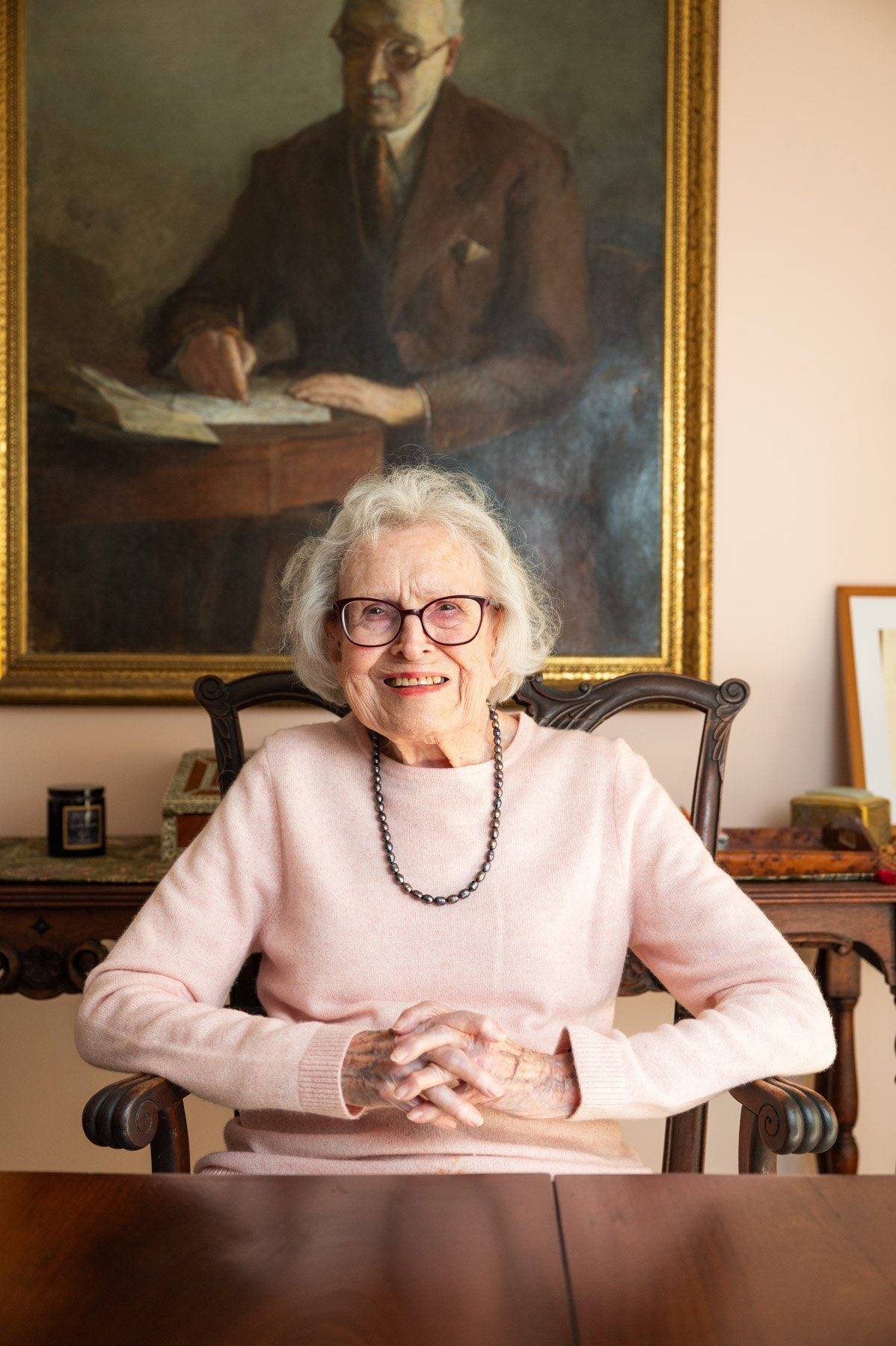
By Amanda MacLaren | Photo by John Michael Simpson
Fourteen years after editor Amanda MacLaren first interviewed Jean Bradley Anderson about her fascination with the past, the two met again this spring in Jean’s Forest at Duke apartment to reflect on life, aging and the curiosity that continues to shape Jean’s days as she approaches her 102nd birthday on June 1. A Philadelphia native who moved to Durham in 1955 when her husband, Carl Anderson, joined the faculty at Duke University, Jean discovered her passion for local history after settling along the Eno River in Orange County and uncovering the stories buried in old cemeteries, land deeds and family records. She went on to become one of the region’s most respected historians and author of the definitive book, “Durham County: A History of Durham County, North Carolina,” originally published in 1990 and last revised in 2011.
*Responses have been edited for length and clarity.
When we spoke back in 2012, you reflected on how your life was shaped by inquisitiveness and discovery. How would you describe this most recent chapter of your life?
As I have grown older and more [physically] limited, my interests have narrowed. I am dependent on books for my main entertainment, and my joy is reading. Next to that, I have become more interested in my family, more dependent on their lives for my interests, and the family has grown quite a lot. I have two children, five grandchildren and four great-grandchildren, and they all live interesting lives. Keeping up with them helps me keep up with the world.
Where do they live?
A number of them are in Columbia, South Carolina. My son lives there, and his older son lives there with his family of three children. I have a grandson who lives in Copenhagen with his wife and child, who is about to turn 1 year old. My daughter’s husband coauthored a book last year [about Greek poet Constantine Cavafy] that made quite a splash, so he was asked to talk about it in many places, including Amsterdam and Greece. It’s been very fun watching the reviews come out and hearing about his adventures.
So it would be fair to say that you still have a strong sense of curiosity.
Very much so, and my [electronic] tablet is my resource. I’m constantly looking things up. It’s remarkable, the information you can get. I feel out of touch when an election comes along, because I no longer get the newspaper, so I do a lot of reading, finding out who the people are.
When we spoke before, you mentioned that you were always optimistic about Durham. How do you feel about it today?
Well, I feel there’s entirely too much forest being cut down to build what I believe are apartments. But if we need the apartments, I suppose they have to be put somewhere. I think we’re going to have to depend on technology to solve our problems. [For example,] I just read about a new industry of furs being made from plants, so we don’t have to kill animals. But along the environmental line, I’m a founding member of the Eno River Association, and I have been very happy about its expansion. When we started, everything was in [founder] Margaret [Nygard’s] pocket. Now, they have [several] employees, incredible growth, and it says a lot about people’s interest in the environment and willingness to support it.
What other changes do you feel have been most meaningful in Durham?
The fact that the population is becoming so diverse and bringing in new ideas and new skills, and that’s all to the good. Having the universities around us that are doing important medical research, too.
What do you hope that people new to Durham understand about its history?
The entrepreneurship of the early settlers, and their willingness to take chances and invest their lives and their skills. [They were] stewards of the city, and willing to put in their time and energy on improving it and improving life here, back when Trinity College was brought to Durham, and then became Duke University. And then, the Research Triangle Park has been a remarkable thing for Durham.
What is your day-to-day life like here at The Forest at Duke? What brings you joy?
We have a very full program of activities here, many classes of exercise, in and out of the pool and on the machines. We have lectures and movies and concert and groups – book groups, poetry groups, art groups. There’s a full slate of things for people to do who have the interest and time to do it. We had a very interesting lecture recently on Josiah Wedgwood and the interests that he had in not only pottery, but in chemistry, and his involvement with The Lunar Society of Birmingham, which included scientists like James Watt, the inventor of the steam engine, and Erasmus Darwin, father of Charles. There’s a wonderful book about their friendship that I enjoyed reading very much.
Do you have any strong friendships?
Yes. I have a very close friend whom I met about eight to 10 years ago here who played ping-pong when I was playing ping-pong, and she loved cats when I also loved cats. And she’s a professional musician, and I was very much a devotee of classical music. So we had those things in common. I have a few friends who I talk to about books.
When you talk about books, do you make recommendations or exchange books?
Well, one of my friends recommends memoirs, and I have another friend who’s a specialist in medieval English literature, and when I was a graduate student, that was my major. So we can talk about those things. She gave a lecture about a book from the Middle Ages and another friend gave me a book about the art collection in Philadelphia that’s very famous, called the Barnes collection. Albert Barnes was a fanatic about art, and spent a fortune buying up Renoirs and Picassos and Matisses, all the Impressionists and even African art. He made a remarkable collection, which is now very beautifully housed on the [Benjamin Franklin] Parkway in Philadelphia, next to the Museum of Art. I saw it when it was in his own museum house in the suburbs of Philadelphia.
And you’re from Philadelphia, right?
I was born there, and I lived there for 28 years till I was married, and then we lived in Vermont for three years before coming to Duke. I’ve been here since 1955.
So you’ve really seen a lot of change. We spoke when we first met about your book on the history of Durham County. How do you reflect on that legacy now?
Well, I think it’s probably way out of date. The most recent revision was 2011. I think today a lot of it you can find on the internet, and people seem to want to get their information quickly and easily, and I doubt that many people want to sit down and read a long, 600-page book.
Well, I enjoyed it. What are some other pieces of work you produced that you are most proud of?
I think my research into the early history of Durham that nobody had bothered to look into before. Understanding how these farms were settled and then became, because of the railroad, a different kind of place. And I find it very interesting reading about other places to see how they were formed – there are patterns. In the United States, communities would often form around courthouses, while in Britain, clusters would form around churches or mills.
So you’re still learning a lot about history.
Oh, very much. I, alas, can’t go to the libraries and pore over other people’s correspondence, which was my joy. Do you remember when Durham was called “Fat City”?
I vaguely recall the moniker; when was it called that?
Dr. [Walter] Kempner at Duke came up with the rice diet, and famous people came [to Durham] for the lifestyle. Burl Ives, a folk singer who was very widely known and listened to, came for the rice diet. Durham became known as the diet capital of the world [in the ’40s and ’50s]. Somebody could write a very entertaining book about that.
So what do you think contributes to a long and full life?
I think luck plays an enormous part, and luck is often good genes, if you happen to inherit the right combinations. And, moderation in everything. Balance. No binges – of any kind.
Is there anything in your life that matters even more to you now than maybe it did in the past?
Health, because that’s constant. I have had a very long and a very comfortable old age without worries. I had very good luck with my health, until I turned 100 when I got A-fib and pneumonia in the same year. That was really the first time I had had anything more than the usual ills. I have a great deal of arthritis, which bothers me in my neck, and osteoporosis.
I can name all these physical changes, but I try to live one day at a time. I feel extremely lucky in my life and in my aging, because so many people are afflicted in their late 70s, early 80s, and I have had these extra 20 years; that was a great gift.
Now that I have the time to enjoy poetry and words, language means a lot more to me than it did before. The written word, I would say first of all, but music, too, and most important for me, has been memory. I’ve had a good memory ever since childhood.
Do you have any particular memories that you enjoy reflecting on?
I’m often surprised by things my mind throws up. I try to remember things to tell my children about the past, and recently I was reading a poem called “The Barrel-Organ” by Alfred Noyes. The poem is about an organ, caroling across a golden street in the evening, when the sun sinks low. “The music’s not immortal, but the world has made it sweet and [fulfilled] it with the sunset glow,” and so forth, and the rhythm is like the barrel organ.
I suddenly remembered [from my childhood], there was an organ grinder who came around late in the afternoon in the city streets with a barrel organ mounted on something like a wheelbarrow, only it had four wheels, and handles, and he’d lift and push it from street to street. He’d take up a stance in the middle of the block and play. It went through this repertoire of maybe six different tunes, so that they were always the same and always the same length of time and so forth. He just had to turn the handle. And he would go around often with a monkey on a string. If we heard the organ grinder, we’d run into my mother’s bedroom and she would get together a nickel and maybe a few pennies, and wrap them up in newspaper, and we’d throw them out the fourth-story window. The monkey went and picked up the coins, took them back to the organ grinder and tipped its hat. It was charming.